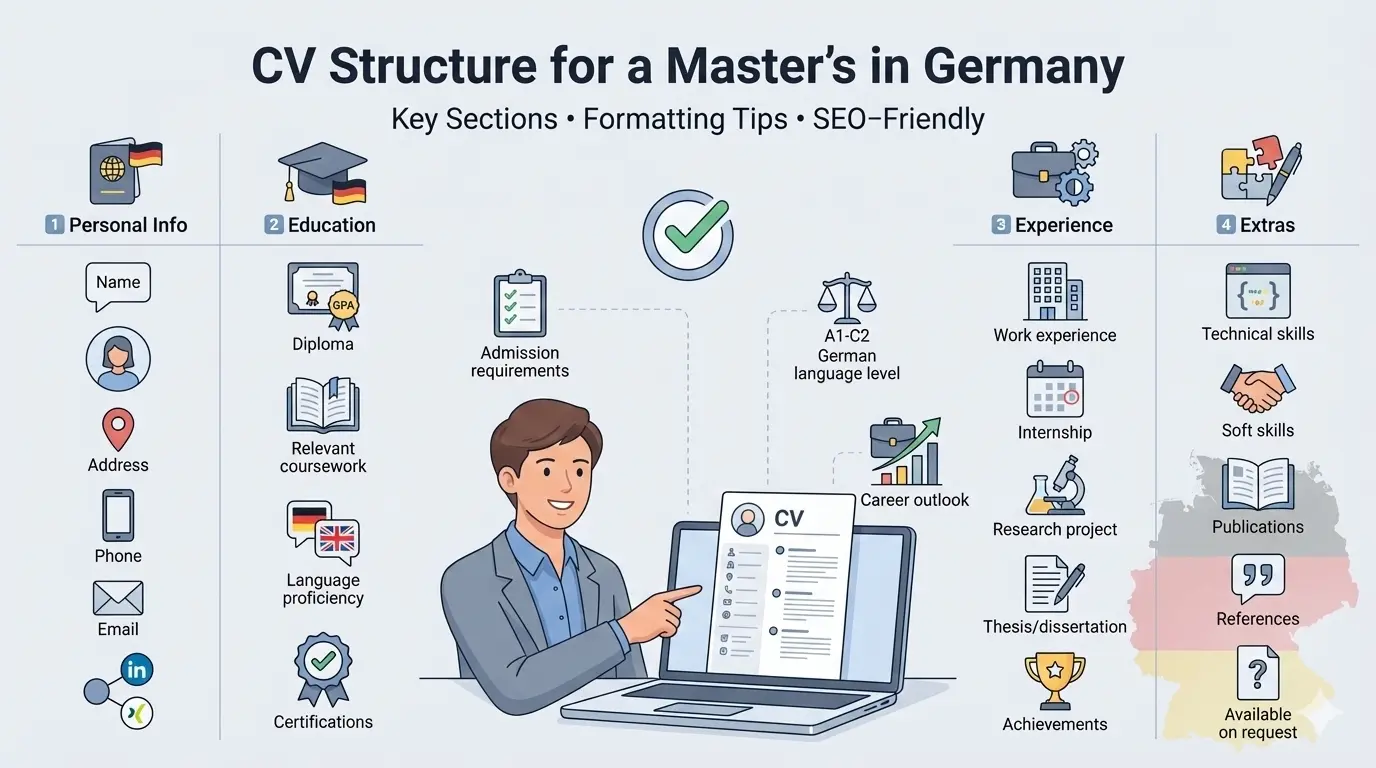
CV Structure for Master’s Programs in Germany (Very Important!)
Applying for a master’s degree at a German public university requires more than great grades. Admissions committees look for a clear, concise, and European‑style curriculum vitae (CV) that showcases your academic background, professional experience, and readiness for advanced study.
Why a Proper CV Matters
German institutions follow a strict, merit‑based selection process. A well‑organized CV demonstrates professionalism, attention to detail, and alignment with the expectations of German academia and future employers.
Essential Sections for a German Master’s CV
- Personal Details: Full name, city & country, email, phone number, LinkedIn profile (optional).
- Short Objective (About Me): 2–3 lines summarising your background, research interests, and master’s goal.
- Work Experience: Role, company, duration, and bullet‑point key responsibilities or achievements.
- Education: Degree, university, country, study period, and CGPA/percentage.
- Skills: Technical tools, programming languages, laboratory techniques, or other core competencies.
- Publications (if any): Title, journal or conference, year, and co‑author information.
- Projects: Academic or personal projects, brief description, technologies used, and outcomes.
- Language Skills: English (IELTS/TOEFL score), German proficiency level (A1–C1).
- Certifications: Only include relevant and reputable certifications.
Best Practice: Use the Europass CV Format
The Europass CV is widely accepted across German public universities. It provides a clean layout and standardised sections that match the expectations of admission panels.
👉 Create your Europass CV here
Career Scope and Job Opportunities in Germany
A strong CV not only helps you secure a master’s place but also positions you for internships, research assistantships, and full‑time roles after graduation. Germany’s thriving engineering, IT, and renewable‑energy sectors actively recruit graduates with solid academic records and practical experience.
Final Tips
- Keep the CV to one page (two pages if you have extensive work experience).
- Use a professional font (e.g., Arial, Calibri) and 10‑12 pt size.
- Proofread for spelling and grammar errors.
- Tailor the objective and key achievements to the specific master’s program.
Need Personalized CV Assistance?
DeutschlandGenics helps you craft a perfect Europass CV, optimise content for German public universities, and prepare a compelling application package.